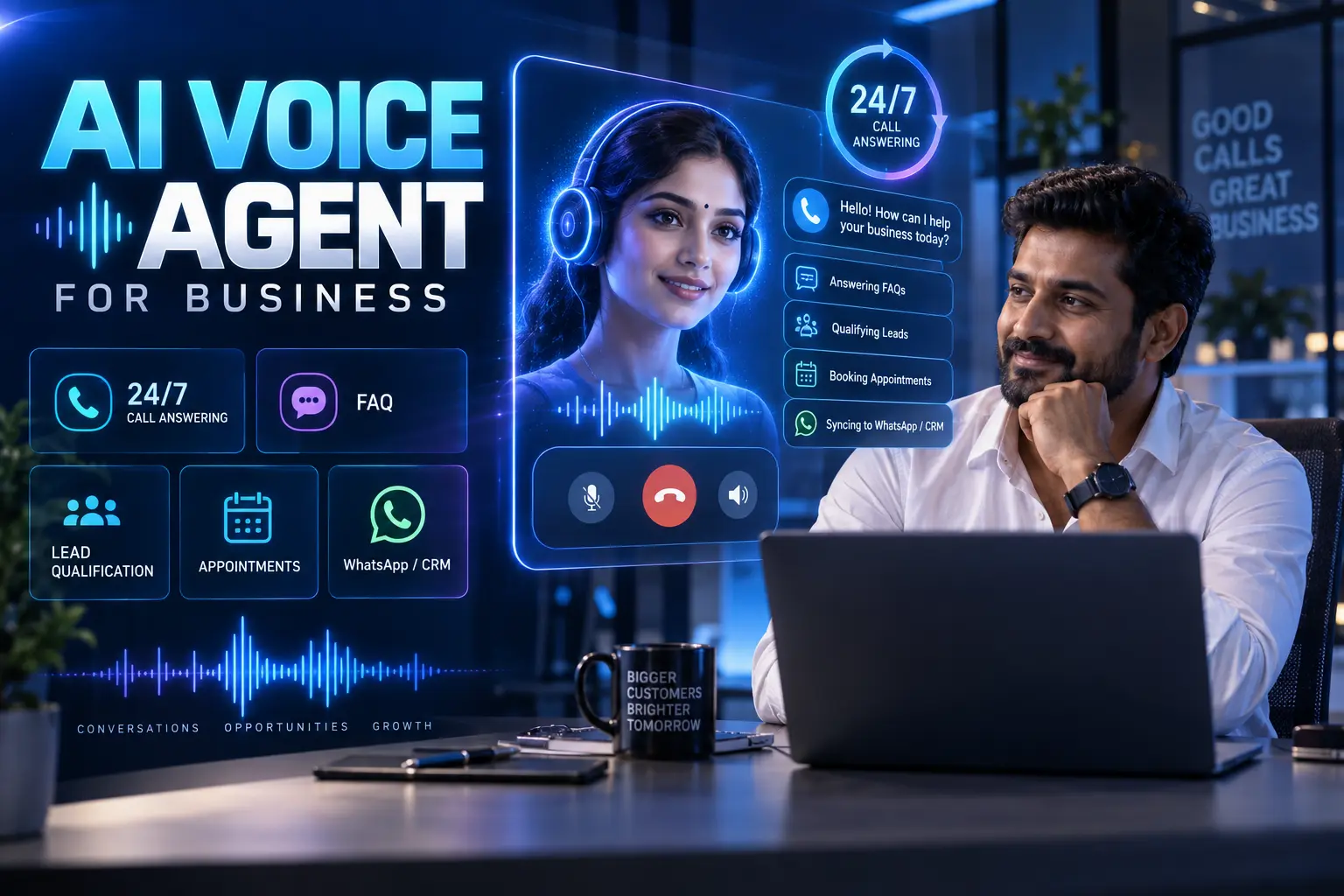
How an AI Voice Agent Supports Business
First, an AI voice agent can answer inbound calls, speak with customers and follow defined conversation rules. It can handle routine questions and collect details.
In addition, businesses can reduce missed calls and maintain a more consistent first response.
24/7 Call Answering
Moreover, customers may call outside office hours or when staff are busy. An AI voice agent can remain available within configured service and telephony limits.
As a result, it can greet callers, identify needs and guide them through approved options.
Frequently Asked Questions
Furthermore, the agent can answer common questions about services, locations, timings, availability and processes.
Consequently, responses are based on configured knowledge and should include escalation rules when the answer is uncertain.
Lead Qualification and Detail Collection
Moreover, AI voice agents can collect names, phone numbers, requirements, preferred dates, cities, budgets and other fields.
In addition, structured data helps the sales team understand the enquiry before follow-up.
Appointments and Call Routing
Furthermore, depending on connected tools, an agent can support appointment requests, call transfers or scheduled callbacks.
As a result, human escalation remains important for complex negotiations, complaints and high-value decisions.
Multilingual Customer Conversations
Moreover, businesses serving diverse customers may configure suitable languages and conversational styles based on voice availability.
Consequently, clear prompts, testing and approved wording are necessary to maintain accuracy across languages.
WhatsApp, CRM and Notifications
Furthermore, after a call, the system can send structured details to supported WhatsApp, email or CRM workflows.
In addition, recordings, transcripts and logs can support quality review when configured lawfully.
Why Choose Halo AI from Lights Onn iTech?
Most importantly, Lights Onn iTech connects AI voice conversations with business workflows, websites, lead generation and automation.
Therefore, we configure questions, knowledge, escalation and reporting based on your requirements.